Showing posts with label engineering. Show all posts

Saturday, 11 October 2014

ScienceGrrl: Science is for Everyone


On the 8th October, I went along to the Arts Tower at the University of Sheffield to attend the first inaugural lecture titled 'Science is for Everyone' by ScienceGrrl's Sheffield branch. 

The lecture began with Jen Lewis (founder of ScienceGrrl Sheffield) asking people to picture a typical scientist and engineer, something I have written about before here. Jen then showed a picture of Ada Lovelace and asked the audience if anyone knew who she was. It's safe to say that not many people did (or they were being extremely shy!). The lecture itself was arranged to coincide with Ada Lovelace day on 14th October, which is a celebration of the achievements of women in science. Ada is often associated with being the worlds first computer programmer after sketching out programs and plans for something called the 'Analytical Engine', which was essentially an early version of the modern computer.


Ada Lovelace Day - 14th October
Next up was the main speaker of the evening, Professor Elena Rodriguez-Falcon, a Mechanical Engineer and Enterprise Educator at the University of Sheffield. She told us her story and how she became involved in the field of engineering. Elena is originally from Mexico, where she studied. There she met a new friend who had a disabled brother. Elena was astounded at the way his family had made a hand-brace for him. This was engineering. She was determined to help disabled people complete day to day activities and she discovered she could do this through engineering. 'Everything is enabled by science and engineering' and so these pathways make just as much difference to people's lives as medicine can. 

Professor Rodriguez-Falcon has spent her career dedicated to helping those with a disability through her knowledge of engineering. Someone with a 'disability' may not just be someone who was born with a physical/mental disability, as she explained that we all become disabled in one way or another as we age. She showed that the number of elderly people with a physical disability will be 50% of the population by 2020. As our strength and dexterity deteriorate as we get older, it becomes harder to do day to day chores and clever engineering solutions are the way to overcome this. Elena's talk was incredibly inspiring and it was extremely helpful of her to give an insight into what you can do with engineering and how helpful it can actually be to people. When you say the word 'engineering' people often think of cars or aeroplanes and vehicles, but actually it is so much more than that and the career possibilities you can get from engineering are endless. 

We then heard from some PhD students from the University, all ScienceGrrls and hence involved in STEM subjects. They were kind enough to talk us through their research and all four of them were involved in entirely different fields:


  • Firstly we heard about the subject of Bone Regeneration and the engineering behind aiding the recovery of broken bones through inserting a material between the gaps in the broken bone to speed up recovery. 
  • The second short talk was on Additive Manufacturing, or 3D printing as we all know it. The technology behind 3D printing is extremely cool, not only because you can make a 3D replica of your own face (really!), but really thin slices of material in any shape needed can be produced by the printer. This is very useful for the Medical, Automotive and Consumer Industries. 
  • We then heard from Priya, a member of Sheffield's NeuroGirls, who was researching Vasomotion and the dilation and constriction of arteries in the body. She told us that vasomotion is extremely useful in medicine as it can help predict whether a patient is developing a disease, before the disease is actually apparent. 
  • Lastly, we heard from another ScienceGrrl, Steph, who began as a chemist who was interested in environmental chemistry and is now an environmental engineer studying groundwater and the microbiology to clean up groundwater after petrol leaks. I found her talk most interesting as I think I could relate to it most, however all of the girls were absolutely amazing and so passionate about their fields and projects. 
At the end of the lecture, there was time for questions:

The first question asked Professor Rodriguez how she decided what kind of engineering she wanted to study. Elena replied that she didn't actually know what career she wanted, so she chose mechanical engineering as it is a very broad field and she decided it would be best for her as she could specialise later if she wanted to. Some of the other ScienceGrrls also said this and some said they 'fell' in to engineering; it wasn't their initital career plan but they discovered that they really enjoyed finding practical solutions to problems faced in the world. 

Following questions discussed the gender imbalance in engineering subjects at University and in Industry. Elena was quick to reassure people that she had never experienced discrimination even whilst working at a company where she was the only woman amongst 200 men. She said that the actual problem is not the vast number of boys in STEM, but the number of girls not taking STEM subjects. 

'That's not to say we're not awesome.
 We are brilliant!' 
- Professor Elena Rodriguez-Falcon on the lack of women in engineering


I had the most enjoyable evening at the lecture and I hope it inspired all of the younger people in there to study STEM at University. It was really good to see people of different ages and there were more boys there than I expected there to be, which was amazing to see. I really hope ScienceGrrl Sheffield hold more events like this at the Uni. I'd like to thank them all for giving up their time to share their knowledge and passion with us. You're an inspiration. 

Saturday, 2 August 2014

What does a scientist look like?

Whilst reading the latest issue of Chemistry World, a monthly magazine I receive for being a member of the Royal society of Chemistry, I came across an article about Martyn Poliakoff, a professor of Chemistry at the University of Nottingham. He is the foreign secretary of the RSC, meaning he has an influential role in the international business of the Royal Society. Despite this, he is most famous for his insightful and entertaining Youtube videos on the channel 'Periodic Videos'. Poliakoff and his team at Nottingham worked to produce informative videos on every element in the periodic table and have now moved on to even cooler chemistry concepts and experiments such as heating up Creme Eggs (an absolute must-see) and the classic experiment; the Iodine clock.

Heating a creme egg. 

 Professor Poliakoff himself is the epitome of  your 'stereotypical scientist', his wild grey hair and glasses make him the received idea of a scientist we've all come to know. But, as Poliakoff states 'Part of my mission is to show that not all scientists look like me'. Whilst Poliakoff acknowledges his own appearance, he makes viewers aware that there are people out there in the field of science who do not look like him at all. His team at the University of Nottingham comprises of men and women of different backgrounds and ages. It is good that he acknowledges the stereotype and recognises that there needs to be more diversity. His work in Ethiopia has been invaluable in getting more African scientists into the international community and he has said 'My long term vision is that Ethiopian scientists should go to an international conference and nobody should think it surprising'. He is truly an ambassador for diversity.

When you picture a scientist you probably think of an old man with crazy Einstein-like hair and glasses, wearing a white lab coat, not unlike Professor Poliakoff. Whereas if you look at real people who have careers in STEM fields, they come in all shapes and sizes, different ethnic backgrounds and of course, different sexes. I believe that challenging the stereotypical image of a scientist is the one of the most effective ways to introduce more diversity into the fields. If you have this view of what someone in a chosen career path 'should' look like then you are alienating everyone who doesn't look that way. Therefore, girls and ethnic minorities may be less inclined to take up science if they are unable to see how they 'fit in' and if there is no one who they can relate to. The image of a scientist we have all grown up with is an ageing white man, yet first and foremost, a scientist is a person, someone with passion and curiosity. That's it. These preconceptions of what a scientist is, damages the opportunity to diversify the scientific industry. I am glad that there are people like Martyn Poliakoff in the world who want to confront this out of date vision.
I'm a scientist! No grey hair to be seen!
Obviously, I am passionate about getting more girls into STEM subjects and I just wanted to let any girl reading this know that you can be a scientist/engineer/mathematician, regardless of your appearance. Science doesn't care about how you look, it cares about your mind and how you think and your passion for the subject. People shouldn't be scared of following their dreams because they can't relate to the image of what they should be. There are so many fabulous female scientists and organisations, such as the Stemettes, who promote diversity and gender equality in the field, so why are we still stuck on this grey haired character who is so obsolete in today's society? The days of balding men in suits sat round a table discussing gravity is long gone. It's time to make way for a new 'face of science', one that represents all cultures and backgrounds.

Tuesday, 29 July 2014

Planetariums, Stars and Spacecraft..

In today's society, we spend a significant proportion of our lives staring at television and computer screens trying to keep up with the world. By doing this we often forget to look at our own planet, especially the sky. If you're new to physics and all this space-y stuff (as I am), then a planetarium is a great way to explore the skies and learn about the feats of mankind in exploring the planets, whilst remaining warm.

I was lucky enough to visit two planetariums whilst on a recent trip to Newcastle and both were equally fabulous. First, I visited the Centre for Life which I have mentioned in a previous blog post, where I watched a short film titled 'Back to the Moon for Good'. The film faded in to millions of stars and you felt like you were floating in outer space, miles away from civilisation. Amazing graphics took you on a journey through the cosmos and told you the story of the first moon landing and why no one has been back since.

Google Lunar XPRIZE
Debts and austerity mean days of exploring planets are the last thing on governments minds as obviously getting to the moon isn't the most cost-effective enterprise. However, the Google Lunar XPrize, initiates the  race to the moon once again. 33 teams from all over the world must build a spacecraft which can successfully land on the moon, travel 500 metres across the surface and send images back to Earth. The best part? The teams expenses must be no more than 10% government funded, meaning getting to the moon on a budget! Who knows, one of these teams may revolutionise rocket building as we know it and design a cheaper way of sending spacecraft into orbit, meaning more missions could take place. Exciting stuff. The deadline of the competition is December 31st 2015 which really isn't that far away. It's brilliant that people from all over the world can have a go at sending something they have designed themselves into the skies. Many teams rely on volunteers to aid the success of their project, and it gives a chance for people not originally from the field of physics to get involved. The film showed that one team member was a neuroscientist who compared the building of a rocket to the human brain and all the processes that go on are delicately intertwined. I cannot convey how much it made me want to be a physicist (and this is coming from a chemist). The winning team will receive the grand prize of  $20 million and I imagine will go down in history. Since watching the film, I've been reading a lot about the respective teams and all of them have chosen different ways of approaching the challenge and comprise of different scientists and engineers from different fields; it's truly inspiring.

Whilst also in the North-East, I visited the Great North museum, previously the Hancock, which also blew me away with it's planetarium. You have to pay for the planetarium at this venue, but it's not expensive at all. I paid £1.95 for a film titled 'Dawn of the Space Age' which was around 40 minutes long. Not bad at all, and totally worth it! In 'Dawn of the Space Age' you relive space exploration, starting from the first time an artificial satellite was launched, through the space race where the Soviet Union and the USA battled to see who could get into space first. The Soviets won with the launch of Sputnik 1 in October 1957, and the battle continued to outdo each other, resulting in the USA's Apollo 11 landing in 1969, whereby the first humans set foot on the moon. As someone who has only recently developed an interest in space and doesn't really know much about space travel, it was enlightening and entertaining to be taken through the growth and advancements of spacecraft through the ages. Being the feminist that I am, I only have one issue with the film and that was that much emphasis was placed on the first man on the moon, but not on the first woman in space. Valentina Tereshkova was the first woman in space and was on board the Soviet's 'Vostok 6' which launched 16th June 1963. The Great North has many other planetarium shows available to watch and I thoroughly recommend visiting any planetarium. Learning about space is fascinating and opens up so many questions that you want to find the answers to. It's great if you're an inquisitive individual.


Friday, 25 July 2014

My love for Science museums

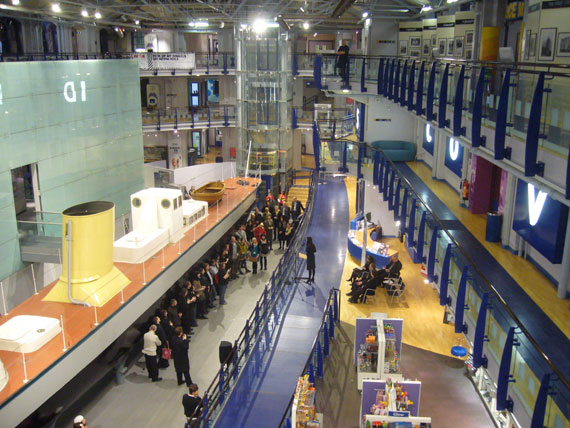
During my time in Newcastle, the most outstanding place I have visited has been the Centre for Life. Situated in Times Square, Newcastle upon Tyne the centre attracts around 250,000 visitors a year and is the 'largest provider of school science workshops in Europe'.

Curiosity Zone
The centre provides all sorts of activities including the 'Curiosity Zone' where science activities are provided to children, along with instructions' (sometimes) but the actual aim of the activity is not given. The curiosity zone aims to replicate research and development and compares research to a 'formal sort of play'. I fully agree, as all scientific research involves some playing around with concepts or reactants; the path is never straightforward and and the target almost never met first time around. I really loved the idea of leaving children to make what they wanted of the equipment provided and explore it for themselves without an adult telling them what they should be doing. Each child approached activities in a different way and had different ideas of what they 'should' do or what the equipment was used for. It's a great way to inspire budding scientists and give children an opportunity to 'think like a scientist'.


Some of the activities on offer in the Curiosity zone included 'The Reactable', a table where you can create sound using programmed shapes. The sound can then be adjusted by placing other shapes next to those already laid on the table, as the pucks interact with each other. Hence by using the process of placing shapes carefully and adjusting and fine-tuning the sounds you want, you can create a digital musical masterpiece. The Reactable aims to encourage creativity and curiosity and all in all is fun to play around with. 
 A video of me dancing to our own musical masterpiece. I have some seriously groovy dance moves going on that I sincerely apologise for. 


When I first got there I was already extremely excited, but my excitement got taken to a whole new level when I saw that one of the exhibitions on show was 'BODY WORLDS vital', which is an exhibition by Dr. Gunther von Hagens, using real human bodies. Dr von Hagens invented the technique of plastination in 1977 whilst working as an anatomist in Germany and the exhibition is approved by the Human Tissue Authority. To see real human bodies and the amazing things they are capable of is truly fascinating. Real people may donate their bodies to plastinated after they pass away and although this may seem a little grim, the result is a display of amazing exhibits informing the audience of how the human body works and how to live a healthy lifestyle. Samples of healthy lungs compared to those with emphysema and lung cancer can be seen and it's shocking to see how much damage you are capable of doing to your body. Although a lot of people are initially unsure about the exhibition, it is there to spread a good message about the importance of life. Of course photographs are not allowed to be taken inside the exhibition, after all these are people's bodies and must be respected, so I took a picture of the poster instead.

I also visited the centres Planetarium, however I'll leave this for the next blog post as I've been fortunate enough to visit two planetariums in two days, so I'll leave the awesome space stuff for later. :-)


Wednesday, 23 July 2014

North-East Adventures

Kielder Water
So I'm currently sat in my boyfriend's bedroom in Wallsend after the most incredible week of sightseeing and new experiences, and I still have another five days here. I went camping for the first time, which was fab and the toilet block had Dyson Airblades which I'm a huge fan of and I imagine it's rare for a campsite to have such luxurious hand-drying facilities. If anyone wishes to visit said campsite with fabulous toilets I'll leave the link below. We camped just outside of Bellingham (which I learnt is NOT pronounced Belling-ham) at Boe Rigg campsite. The area is amazing, there's so many beautiful sites to see, including Kielder Water and Forest Park. Being the science fanatic I am, I of course wanted to visit the observatory but unfortunately all events were fully booked. I will visit one day when the skies are clear. :-)

If you're a fan of conservation and wildlife, there are many species that can only be seen in this part of the country, including red squirrels.  Kielder is home to 50% of the native red squirrel population and much information can be found about the conservation work being done to protect this beautiful species. Also to be seen are Ospreys, some of the most fascinating birds of prey.

Discovery Museum
Yesterday I visited the Discovery Museum in Newcastle, the first science museum in Britain to be built outside of London. The place is vast with so much to 'discover', literally; I could have spent all day in there. There is an exhibit which takes you through the history of the Newcastle, from the Romans building Pons Aelius to the modern day. Of course, my personal favourite was the science maze. The maze takes you through the basics and fundamental concepts of science including: forces, how sound travels, electricity, and light and vision just to name a few. There are activities to try throughout the maze such as a ball game involving magnets and seeing how much electricity you can generate simply by completing a circuit using your hands and how the voltage increases when your hands are moist. It's a brilliant way for young people to gain  an interest in science; there were so many little children bewildered by making their own circuits and standing in front a kaleidoscope mirror. It's lovely to know that this brilliant exhibition might inspire one of these young children to take up science. The gift shop is also filled with sciencey goodness, I especially wanted the crystal growing kit. :-)

I still have to visit the Centre for Life and the Great North Museum amongst other things, so I'll write a little review of those next week.

Boe Rigg campsite

Kielder Water and Forest Park

and for any astronomy enthusiasts: Kielder Observatory

Discovery Museum

Wednesday, 9 July 2014

Kelham Island Museum

After exams had finished, my boyfriend and I decided to fully exploit the length of our accommodation contract and stay in Sheffield for a couple more weeks after the majority of people had moved out. We decided to do 'tourist' Sheffield and go to the sites that we would want to see if we were only visiting for a short period of time.

On our list was Kelham Island and specifically Kelham Island Museum. It sounds odd to have an 'island' in the centre of the steel city, but the previously the area has been home to many factories and was mainly industrial so a small ditch/trench was built that allowed water to reach the water mills. Hence the island was created.

As a lover of all types of museums and having recently covered the production of steel and metals as part of my degree course, I couldn't wait to get to to Kelham Island to visit their famous industrial museum. As you approach the museum, the first thing you see is a huge Bessemer converter outside. Bessemer converters were used to make steel from molten pig iron. Pig iron is iron with a fairly high amount of carbon, up to 4.5% by composition. The molten iron is placed into the Bessemer converter and the idea is to remove impurities such as silicon and carbon as oxides using the process of oxidation. Oxidation also heats the converter meaning the iron inside remains molten throughout the process. Other substances could then be added to the molten steel to make the desired product. 

The Bessemer converter at Kelham Island Museum (Source)
From the outside the museum looks relatively small compared to the disused and abandoned factories that surround it, and of course the Bessemer converter. However, once inside, the place really is amazing and much bigger that expected. I was surprised at how big the museum actually is and it covers everything from the origins of the City of Sheffield including the city cannons, to the stories of women working in the factories, which I found particularly fascinating. 

There is a part of the museum that focuses on the making of cutlery in the surrounding area and there are so many beautiful artefacts including a pair of silver scissors beautifully engraved and in the shape of two birds. Apart from the Bessemer, I'd say the museum's main attraction is the River Don Engine in the engine house. Several times a day, they turn the engine on for visitors to watch it in action. Unfortunately we didn't know what the loud noise and banging was until we turned the corner and the spectacle was over. :( 
The River Don Engine (Source)
I really enjoyed Kelham Island Museum, it's such an interesting place. If only I'd visited before my exam...

Sunday, 6 July 2014

My favourite females

As you've probably guessed by now, I'm all for getting more girls into STEM subjects and science outreach is something I'm really passionate about. It's obvious that throughout history, women in science and technology have been overlooked and their ideas and achievements not seen as important as those of their male counterparts. Whilst referring to women who happen to be scientists as 'female scientists' doesn't exactly help with striving for equality between the sexes in STEM fields (afterall we don't refer to men as male scientists), there have been some pretty damn good women in science and I thought I would share my favourites.

This is a list of women from STEM fields who inspire me. I've purposely left Marie Curie out of this list because in case you didn't know, she's not the only women who has played a role in pushing science into the 21st century. Also, some of these women are living today and that's just fab; these women are role models for girls like me and inspire me to continue in my field and make a career out of it in the hope that one day, I'll achieve great things too. So here it is, AWESOME WOMEN ALERT.

1. Hedy Lamarr
In my opinion, one of the most beautiful women ever, Hedy Lamarr also happened to be extremely intelligent. She and George Antheil invented an incredibly sophisticated piece of electronic engineering which they called the 'Secret Communication System' whereby frequency hopping was used to prevent infiltration of signals from radio-controlled missiles. Simultaneously, the radio frequencies of  missiles would change, preventing enemies from detecting the signals.
Hedy Lamarr

Most people would say that she 'doesn't look like a scientist', however she proved that it's possible to have beauty and brains. As a woman, you can have it all, you don't have to choose between being intelligent and being attractive.

The woman who was one of the most popular Hollywood actresses of her day also had a room in her house reserved for drafting ideas and the shelves filled with engineering books. I find the fact that she was extremely creative both inspiring and fascinating because as well as being an actress, she also applied her creativity to engineering and problem solving and helped pave the way for modern day technologies mobile phones.


2. Dorothy Hodgkin
Dorothy Hodgkin won the Nobel prize for Chemistry in 1964 and quite rightly so. X-ray crystallography is a common method used by chemists today and Hodgkin advanced this and discovered the 3D structures of some of the  most important biomolecules. I learnt about Dorothy Hodgkin in one of my lectures about medicine and chemistry. She found the structure of penicillin, a chemical so often used in treatment and therefore made a significant contribution to both chemistry and medicine as often in science structure determines function. She also discovered the 3D structure of insulin and also taught students, notably Margaret Roberts (later Margaret Thatcher).
Dorothy Hodgkin

3. Rosalind Franklin
Rosalind Franklin
When people think about discovery of the structure of DNA, most people associate James Watson and Francis Crick with this amazing feat, after all they were awarded with the Nobel prize in 1962. However what allowed them to recognise the 'double helix' as DNA's structure was the x-ray images of DNA produced by Franklin. She practised x-ray crystallography techniques many times and had received a doctorate in physical chemistry. Unfortunately she died before the Nobel prize was awarded to Watson, Crick and Wilkins (another scientist involved)

.


4. Helen Sharman 
I love Helen Sharman. It might be because I'm following in her footsteps by doing the same degree at the same University, but nevertheless, she is truly inspirational. She also deserves to be on this list because she was the first British person in space. What's cooler that being an astronaut?


Helen Sharman


5. Natalie Portman
Okay, so when you think of Natalie Portman, you don't automatically think 'scientist' but this woman has serious brains. As well as being my ultimate woman crush and all round Hollywood beauty, she's been published in scientific journals, as well as a writing a paper titled "A Simple Method to Demonstrate the Enzymatic Production of Hydrogen from Sugar." Basically, I want to be Natalie Portman.

Follow my blog with Bloglovin