Showing posts with label physics. Show all posts

Saturday, 30 August 2014

'An Astronaut's Guide to Life on Earth'


Disclaimer: I admit that I'm extremely late jumping on the bandwagon by reading this book, but space exploration is something I've only recently become interested in, thanks to all the amazing astrophysicists I follow on Twitter. So thanks, spacey people. I applaud you. 

Probably one of the best books I have ever read, 'An Astronauts Guide to Life on Earth' is a self-help guide as much as it is a fabulous tale about Chris Hadfields experiences both on Earth and in space. I had to stop myself from reading it all in one day just so I could savour how good it is and I can't recommend it enough, especially to those people like me who at times don't have a lot of faith in themselves when it comes to achieving their dreams. It's truly inspiring and I just can't praise it enough.

Chris has faced so many knock-backs and unfortunate circumstances, some of which he couldn't control, like being Canadian! He knew there was a slim chance of NASA ever wanting to send a Canadian into space when there were so many Americans wanting to fulfil the role. Yet, he never let this stop him. Instead, he persevered and worked hard, becoming a fighter pilot, working weekends and completing extra training exercises in the hope of taking a step closer to becoming an astronaut. He says at the beginning of the book that he has wanted to be an astronaut since he was nine years old and first saw the moon-landing. Since that day he has taken every measure possible in order to achieving that and it's amazing that someone can be so dedicated to a particular goal.

Chris Hadfield

Whilst not everyone wants to be an astronaut, Hadfield provides valuable advice for people pursuing any career. He talks about the power of negative thinking and truly being ready for anything that may stand in your way of achieving your goals. Possibly the best thing I took away from the book is the quote coined by NASA- 'Working the Problem'. It's a methos NASA use of approaching a problem by 'descending a tree' and working through the problem in a logical and methodical way, covering all possibilities. The problem could be anything from a fire on-board the ISS or a complex maths problem, yet the process is still the same. I've tried to incorporate this quote into my way of thinking when I encounter a tough question that must be solved. It gives you a lot of faith that you actually can succeed if you in overcoming an obstacle that requires 'out of the box thinking'. There is always a solution.

The book is full of amazing career advice and tips, particularly to never measure your success by whether you achieve your goals the way you wanted to. Working hard and enjoying the journey is just as important as the final destination, because we might not always end up where we originally planned and if we measure our success on our journey's-end then we will always feel disappointed. This has filled me with optimism about returning to University to work hard, prepare and enjoy myself.

It's not all deep life-lessons though.  Before reading this book, I knew nothing about life in space, simply because I've never been and as I said earlier, it's only just become an interest of mine. I was really happy to discover it's exactly as I imagined it. Reading about the physical effects on the astronauts bodies both in space and when they return to Earth is amazing. By the sounds of it though, it all seems very worthwhile. The stories of races under zero gravity through the ISS to gather bubble wrap, preparing breakfast and carrying out scientific experiments by having to stick test tubes to the walls via Velcro. It's all fascinating. I can only imagine what it's like to look out of the window and see the Earth. It must be incredibly beautiful. If you haven't read 'An Astronauts Guide to Life on Earth', please do. I can't stress how brilliant it is.

Friday, 22 August 2014

Useful Books for Undergraduate Chemistry Students

I love books, like really love books. If you're starting University and studying the physical sciences, I've devised a list of books that may be useful in your first year of University. Every Uni has their own list of recommended reading but obviously not all lists will contain the same books, so I've taken some books that my department recommended and some I discovered myself, that have been really helpful/interesting, so I hope this is of some use if you want to get some books together before starting your course. :-)


  • This book is awesome. It may say that it's for A level Chemistry, but it's full of exercises and calculations that cover all aspects of Chemistry. It's really good for revising your maths skills and working through problems. It also has example problems at the beginning of each chapter so you know how to calculate the answers yourself and it's just really useful if you want to revise answering calculation questions. You can buy it here: Calculations for A-level Chemistry


  • Another Maths book specifically for those undergraduate students studying the chemical sciences without having done A level maths. Again, example problems are given and it covers everything you will cover in your first year maths catch-up lectures. Covers lots of different topics such as differentiation, integration and matrices. You can buy it here: Maths for Chemistry


  • Oxford Chemistry Primers are really helpful. They are small books each focussing on a specific topic in Chemistry and will contain some information that may not be given to you in lectures. They're really good for outside reading, are concise and informative and on the whole, easy to understand. I didn't buy before starting my first year and I really wish I had because generally, the University library will only have a few copies of each and they are really good! I've recently invested in a few to begin my second year and plan on taking them on holiday with me to begin some pre-Uni reading. Just search for Oxford Chemistry Primers on Amazon and there are tonnes of them. Some are more expensive than others and I'm unsure why, but I think I got mine for about a penny each. You can't go wrong. 

  • Who says all educational books have to be text books? If you're studying a subject like chemistry, one topic you will cover in your first year will be the structure of atoms and quantum mechanics. It's difficult to get your head around at first because it's like nothing you've ever encountered before and it always reminds me of the famous quote: "If you think you understand quantum mechanics, you don't understand quantum mechanics." This is where Brian Greene comes in. 'The Fabric of the Cosmos' is a brilliant book. It really helped me understand quantum mechanics, probability and Heisenberg's Uncertainty Principle. It's also really good if you're interested in concepts such as time and space etc. Amazon have it here: Fabric of the Cosmos 

There are so many useful books out there to aid you in your university course and don't be afraid to try those that aren't textbooks; sometimes they're more helpful as they have a more personal approach and examples you can relate to. :-)


Thursday, 7 August 2014

Preconceptions of a Scientist

Whenever people ask me what I study at University and I tell them I'm a chemistry student, I usually get responses along the lines of:

 'Wow, you must be really intelligent!' or 'Ooh, aren't you a clever girl?', (which is possibly the most patronising comment ever).

My own personal favourite is 'Oh, but you're so pretty!', simply because it's unrelated to my field and I still can't figure out whether it's a compliment or an insult.

I've recently discussed what people perceive scientists to 'look like', however my experience has told me that these preconceptions of scientists are much more complex than simply appearance. I've even had medicine students ask me what I study and when I tell them they respond with something like 'Eww really? Chemistry's so hard. You must be so clever.' I wanted to remind them that they study medicine, the most competitive University course there is. People have this idea that all scientists are genius' (what is the plural of genius?!) and we sit at desks all day scribbling down complex equations. This may be true of some scientists, who are extremely intelligent and probably make the rest of us look a little dim, however we're not all Einstein and I think this is where the preconceived idea comes from. Einstein is the most well known scientist on Earth and probably the first person people think of when they imagine a scientist. Therefore I think people's thought process is something along the lines of:

Einstein = Scientist, therefore if you are a scientist you must be on the same level as Einstein! Which I know on a personal level isn't true. I am most definitely not a genius. Sure, I have a brain like everyone else, but I am a scientist because I love science and I enjoy it and that is the reason I am good at it. Not because I have an IQ of 1 billion. (Disclaimer: I'm pretty sure you can't have an IQ of 1 billion.)

I think a lot of careers have stereotypes but those of people in STEM subjects are actually quite damaging and I think is one of the reasons there is a lack of women in these fields. Take the 'Big Bang Theory'. It's a funny show and I love it, but when I look at characters like Amy Farrah Fowler, I wonder if I would have chosen a career in science if I had grown up with her character. Probably not. Fortunately I'm lucky enough to know that most female scientists aren't like her at all. Mayim Bialik who plays Amy, is a real representation of a women in science! She's amazing and funny and beautiful with a passion for the subject; she's a true inspiration. However Amy is frumpy, socially awkward and perceived as 'boring'. Maybe I'm taking this too seriously but she really doesn't represent the majority and personally, I don't know anyone like her which makes me wonder where this stereotype comes from.

Yes as scientists,we are a little geeky but we like to have fun as much as anyone else. We love the Universe and the origin of it, we love the Earth, we love the organisms that inhabit the Earth, we love invisible forces the act on you and the atoms and molecules that make up everything. We love the chemicals whizzing around your brain as you're reading this. In general, we love life and the origins of life. How can you possibly say that's boring?

Saturday, 2 August 2014

What does a scientist look like?

Whilst reading the latest issue of Chemistry World, a monthly magazine I receive for being a member of the Royal society of Chemistry, I came across an article about Martyn Poliakoff, a professor of Chemistry at the University of Nottingham. He is the foreign secretary of the RSC, meaning he has an influential role in the international business of the Royal Society. Despite this, he is most famous for his insightful and entertaining Youtube videos on the channel 'Periodic Videos'. Poliakoff and his team at Nottingham worked to produce informative videos on every element in the periodic table and have now moved on to even cooler chemistry concepts and experiments such as heating up Creme Eggs (an absolute must-see) and the classic experiment; the Iodine clock.

Heating a creme egg. 

 Professor Poliakoff himself is the epitome of  your 'stereotypical scientist', his wild grey hair and glasses make him the received idea of a scientist we've all come to know. But, as Poliakoff states 'Part of my mission is to show that not all scientists look like me'. Whilst Poliakoff acknowledges his own appearance, he makes viewers aware that there are people out there in the field of science who do not look like him at all. His team at the University of Nottingham comprises of men and women of different backgrounds and ages. It is good that he acknowledges the stereotype and recognises that there needs to be more diversity. His work in Ethiopia has been invaluable in getting more African scientists into the international community and he has said 'My long term vision is that Ethiopian scientists should go to an international conference and nobody should think it surprising'. He is truly an ambassador for diversity.

When you picture a scientist you probably think of an old man with crazy Einstein-like hair and glasses, wearing a white lab coat, not unlike Professor Poliakoff. Whereas if you look at real people who have careers in STEM fields, they come in all shapes and sizes, different ethnic backgrounds and of course, different sexes. I believe that challenging the stereotypical image of a scientist is the one of the most effective ways to introduce more diversity into the fields. If you have this view of what someone in a chosen career path 'should' look like then you are alienating everyone who doesn't look that way. Therefore, girls and ethnic minorities may be less inclined to take up science if they are unable to see how they 'fit in' and if there is no one who they can relate to. The image of a scientist we have all grown up with is an ageing white man, yet first and foremost, a scientist is a person, someone with passion and curiosity. That's it. These preconceptions of what a scientist is, damages the opportunity to diversify the scientific industry. I am glad that there are people like Martyn Poliakoff in the world who want to confront this out of date vision.
I'm a scientist! No grey hair to be seen!
Obviously, I am passionate about getting more girls into STEM subjects and I just wanted to let any girl reading this know that you can be a scientist/engineer/mathematician, regardless of your appearance. Science doesn't care about how you look, it cares about your mind and how you think and your passion for the subject. People shouldn't be scared of following their dreams because they can't relate to the image of what they should be. There are so many fabulous female scientists and organisations, such as the Stemettes, who promote diversity and gender equality in the field, so why are we still stuck on this grey haired character who is so obsolete in today's society? The days of balding men in suits sat round a table discussing gravity is long gone. It's time to make way for a new 'face of science', one that represents all cultures and backgrounds.

Thursday, 31 July 2014

When Science meets Art

Anyone who knows me can guarantee that I would happily spend all day in an art gallery. Now, I'm not really a fan of contemporary art, I think the meaning behind it is often far too vague and you struggle to see the links between what it says the artwork is about and what it actually looks like. It's really not for me. This was until I saw Mariner 9 by Kelly Richardson, a conglomeration of contemporary art and science.

Now on show at the Laing gallery in Newcastle upon Tyne, Mariner 9 depicts a panoramic image of what Mars will look like 200 years in the future. It is unequivocally striking and a real sight to be seen. But this isn't just an imagined landscape thought up in the artists head, the exhibition was created using data from NASA. Actual scientific knowledge went into the production of Mariner 9 and I think that's what makes it so breathtaking. Richardson worked alongside NASA and used real imagery and technical data from them. She then used a scenery generation software named Terragen to create the hyper-realistic scene of Mars. She even went as far as to replicate the geology and weather found on the red planet.


So what does it look like? The scene depicts the surface of mars, rocks and rovers dominate the landscape and the wreckage of rusting spacecraft lie off into the distance. Light and sound play an important part in the exhibit and the sounds of  rovers moving and the wind howling make the experience feel almost real. As the sun sets on Mars, you feel like you're almost there, alone with only pieces of machinery to keep you company.

MARINER 9 - An interview with Kelly Richardson from Northern Stars on Vimeo.
An interview with artist Kelly Richardson about her work Mariner 9.


Tuesday, 29 July 2014

Planetariums, Stars and Spacecraft..

In today's society, we spend a significant proportion of our lives staring at television and computer screens trying to keep up with the world. By doing this we often forget to look at our own planet, especially the sky. If you're new to physics and all this space-y stuff (as I am), then a planetarium is a great way to explore the skies and learn about the feats of mankind in exploring the planets, whilst remaining warm.

I was lucky enough to visit two planetariums whilst on a recent trip to Newcastle and both were equally fabulous. First, I visited the Centre for Life which I have mentioned in a previous blog post, where I watched a short film titled 'Back to the Moon for Good'. The film faded in to millions of stars and you felt like you were floating in outer space, miles away from civilisation. Amazing graphics took you on a journey through the cosmos and told you the story of the first moon landing and why no one has been back since.

Google Lunar XPRIZE
Debts and austerity mean days of exploring planets are the last thing on governments minds as obviously getting to the moon isn't the most cost-effective enterprise. However, the Google Lunar XPrize, initiates the  race to the moon once again. 33 teams from all over the world must build a spacecraft which can successfully land on the moon, travel 500 metres across the surface and send images back to Earth. The best part? The teams expenses must be no more than 10% government funded, meaning getting to the moon on a budget! Who knows, one of these teams may revolutionise rocket building as we know it and design a cheaper way of sending spacecraft into orbit, meaning more missions could take place. Exciting stuff. The deadline of the competition is December 31st 2015 which really isn't that far away. It's brilliant that people from all over the world can have a go at sending something they have designed themselves into the skies. Many teams rely on volunteers to aid the success of their project, and it gives a chance for people not originally from the field of physics to get involved. The film showed that one team member was a neuroscientist who compared the building of a rocket to the human brain and all the processes that go on are delicately intertwined. I cannot convey how much it made me want to be a physicist (and this is coming from a chemist). The winning team will receive the grand prize of  $20 million and I imagine will go down in history. Since watching the film, I've been reading a lot about the respective teams and all of them have chosen different ways of approaching the challenge and comprise of different scientists and engineers from different fields; it's truly inspiring.

Whilst also in the North-East, I visited the Great North museum, previously the Hancock, which also blew me away with it's planetarium. You have to pay for the planetarium at this venue, but it's not expensive at all. I paid £1.95 for a film titled 'Dawn of the Space Age' which was around 40 minutes long. Not bad at all, and totally worth it! In 'Dawn of the Space Age' you relive space exploration, starting from the first time an artificial satellite was launched, through the space race where the Soviet Union and the USA battled to see who could get into space first. The Soviets won with the launch of Sputnik 1 in October 1957, and the battle continued to outdo each other, resulting in the USA's Apollo 11 landing in 1969, whereby the first humans set foot on the moon. As someone who has only recently developed an interest in space and doesn't really know much about space travel, it was enlightening and entertaining to be taken through the growth and advancements of spacecraft through the ages. Being the feminist that I am, I only have one issue with the film and that was that much emphasis was placed on the first man on the moon, but not on the first woman in space. Valentina Tereshkova was the first woman in space and was on board the Soviet's 'Vostok 6' which launched 16th June 1963. The Great North has many other planetarium shows available to watch and I thoroughly recommend visiting any planetarium. Learning about space is fascinating and opens up so many questions that you want to find the answers to. It's great if you're an inquisitive individual.


Friday, 25 July 2014

My love for Science museums

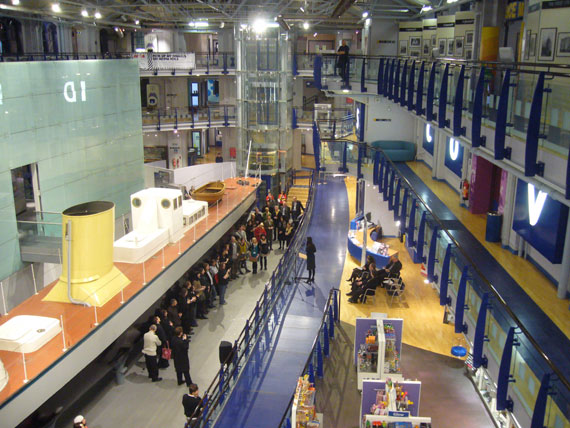
During my time in Newcastle, the most outstanding place I have visited has been the Centre for Life. Situated in Times Square, Newcastle upon Tyne the centre attracts around 250,000 visitors a year and is the 'largest provider of school science workshops in Europe'.

Curiosity Zone
The centre provides all sorts of activities including the 'Curiosity Zone' where science activities are provided to children, along with instructions' (sometimes) but the actual aim of the activity is not given. The curiosity zone aims to replicate research and development and compares research to a 'formal sort of play'. I fully agree, as all scientific research involves some playing around with concepts or reactants; the path is never straightforward and and the target almost never met first time around. I really loved the idea of leaving children to make what they wanted of the equipment provided and explore it for themselves without an adult telling them what they should be doing. Each child approached activities in a different way and had different ideas of what they 'should' do or what the equipment was used for. It's a great way to inspire budding scientists and give children an opportunity to 'think like a scientist'.


Some of the activities on offer in the Curiosity zone included 'The Reactable', a table where you can create sound using programmed shapes. The sound can then be adjusted by placing other shapes next to those already laid on the table, as the pucks interact with each other. Hence by using the process of placing shapes carefully and adjusting and fine-tuning the sounds you want, you can create a digital musical masterpiece. The Reactable aims to encourage creativity and curiosity and all in all is fun to play around with. 
 A video of me dancing to our own musical masterpiece. I have some seriously groovy dance moves going on that I sincerely apologise for. 


When I first got there I was already extremely excited, but my excitement got taken to a whole new level when I saw that one of the exhibitions on show was 'BODY WORLDS vital', which is an exhibition by Dr. Gunther von Hagens, using real human bodies. Dr von Hagens invented the technique of plastination in 1977 whilst working as an anatomist in Germany and the exhibition is approved by the Human Tissue Authority. To see real human bodies and the amazing things they are capable of is truly fascinating. Real people may donate their bodies to plastinated after they pass away and although this may seem a little grim, the result is a display of amazing exhibits informing the audience of how the human body works and how to live a healthy lifestyle. Samples of healthy lungs compared to those with emphysema and lung cancer can be seen and it's shocking to see how much damage you are capable of doing to your body. Although a lot of people are initially unsure about the exhibition, it is there to spread a good message about the importance of life. Of course photographs are not allowed to be taken inside the exhibition, after all these are people's bodies and must be respected, so I took a picture of the poster instead.

I also visited the centres Planetarium, however I'll leave this for the next blog post as I've been fortunate enough to visit two planetariums in two days, so I'll leave the awesome space stuff for later. :-)


Wednesday, 23 July 2014

North-East Adventures

Kielder Water
So I'm currently sat in my boyfriend's bedroom in Wallsend after the most incredible week of sightseeing and new experiences, and I still have another five days here. I went camping for the first time, which was fab and the toilet block had Dyson Airblades which I'm a huge fan of and I imagine it's rare for a campsite to have such luxurious hand-drying facilities. If anyone wishes to visit said campsite with fabulous toilets I'll leave the link below. We camped just outside of Bellingham (which I learnt is NOT pronounced Belling-ham) at Boe Rigg campsite. The area is amazing, there's so many beautiful sites to see, including Kielder Water and Forest Park. Being the science fanatic I am, I of course wanted to visit the observatory but unfortunately all events were fully booked. I will visit one day when the skies are clear. :-)

If you're a fan of conservation and wildlife, there are many species that can only be seen in this part of the country, including red squirrels.  Kielder is home to 50% of the native red squirrel population and much information can be found about the conservation work being done to protect this beautiful species. Also to be seen are Ospreys, some of the most fascinating birds of prey.

Discovery Museum
Yesterday I visited the Discovery Museum in Newcastle, the first science museum in Britain to be built outside of London. The place is vast with so much to 'discover', literally; I could have spent all day in there. There is an exhibit which takes you through the history of the Newcastle, from the Romans building Pons Aelius to the modern day. Of course, my personal favourite was the science maze. The maze takes you through the basics and fundamental concepts of science including: forces, how sound travels, electricity, and light and vision just to name a few. There are activities to try throughout the maze such as a ball game involving magnets and seeing how much electricity you can generate simply by completing a circuit using your hands and how the voltage increases when your hands are moist. It's a brilliant way for young people to gain  an interest in science; there were so many little children bewildered by making their own circuits and standing in front a kaleidoscope mirror. It's lovely to know that this brilliant exhibition might inspire one of these young children to take up science. The gift shop is also filled with sciencey goodness, I especially wanted the crystal growing kit. :-)

I still have to visit the Centre for Life and the Great North Museum amongst other things, so I'll write a little review of those next week.

Boe Rigg campsite

Kielder Water and Forest Park

and for any astronomy enthusiasts: Kielder Observatory

Discovery Museum

Tuesday, 8 July 2014

Science and the education system.

For a while now, people have been talking about why there aren't many girls taking the sciences at A-level, especially physics. I sometimes think that I regret not taking physics at A-level as it's a subject I really enjoy now and it would have helped me hugely during my first year of University. However, the more I think about it, I realise that I didn't choose physics because physics A-level looks extremely boring. I'm not saying that physics is boring; I find it fascinating, especially learning about the origin of the planets and why we're here but at the time of choosing my A-levels, I couldn't think of a more mind-numbing course. I think this opinion can be extended to the majority of the sciences at A-level, as to pass the exams you don't even need to understand key concepts, simply memorise them, throw in some key words and BAM, you've got full marks. Well done you.

Chemistry is obviously my favourite subject, but even I didn't find the syllabus or the way of "learning" during A-level chemistry inspiring at all. Instead of focusing on why certain complexes produce gelatinous precipitates and the chemistry behind this, you simply had to remember to write down the word 'gelatinous' in the exam and you would be fine. I knew this wasn't learning. Okay, there's always going to be key concepts and words that you need to remember because they're important, but the idea behind science qualifications like this isn't understanding, it's memorisation and that's not what science is about. How are young people and especially girls supposed to pick these A-levels when there are no real-life applications behind them? Simply saying 'This is this, accept it. Oh and remember to write this word in your answer.' is not representative of the problem-solving and creative thinking that many scientists use on a day to day basis. This is why I didn't choose physics at A-level. I really didn't enjoy it as a subject at school because I couldn't relate to it. The only part of physics I enjoyed at school was learning about nuclear fission and radioactive decay as we were given actual examples of this. I think when it comes to science, the way you learn is by hands-on experience, not sitting and memorising. Thankfully, I had a brilliant teacher who actually studied chemistry at Uni (a rarity these days) and hence was really enthusiastic about the subject and always throwing in anecdotes and random facts related to what we were learning. I don't hesitate to say that if it wasn't for him, my love for chemistry probably wouldn't have developed as much as it did.

The way A-levels are taught kind of sets you up for failure when you reach University. All of a sudden you have vast amounts of information thrown at you and you quickly realise that memorising it all will be impossible and that's where I suddenly realised that I didn't know how to learn. Thankfully, there are a lot more practical sessions at Uni and these are what most helped me learn the concepts we were introduced to in lectures. My scores in my lab sessions have been consistently high throughout both semesters, simply because I enjoy them and I get to 'do stuff' whether it be carrying out a recrystallisation or playing around with chlorine gas (I use the word 'playing' loosely. Please don't play with chlorine gas.). All in all, the way A-levels and even GCSEs are taught makes science seem like very boring fields, when actually they are amazing and I can't imagine doing anything other than a science degree.
Follow my blog with Bloglovin