Showing posts with label industry. Show all posts

Saturday, 11 October 2014

ScienceGrrl: Science is for Everyone


On the 8th October, I went along to the Arts Tower at the University of Sheffield to attend the first inaugural lecture titled 'Science is for Everyone' by ScienceGrrl's Sheffield branch. 

The lecture began with Jen Lewis (founder of ScienceGrrl Sheffield) asking people to picture a typical scientist and engineer, something I have written about before here. Jen then showed a picture of Ada Lovelace and asked the audience if anyone knew who she was. It's safe to say that not many people did (or they were being extremely shy!). The lecture itself was arranged to coincide with Ada Lovelace day on 14th October, which is a celebration of the achievements of women in science. Ada is often associated with being the worlds first computer programmer after sketching out programs and plans for something called the 'Analytical Engine', which was essentially an early version of the modern computer.


Ada Lovelace Day - 14th October
Next up was the main speaker of the evening, Professor Elena Rodriguez-Falcon, a Mechanical Engineer and Enterprise Educator at the University of Sheffield. She told us her story and how she became involved in the field of engineering. Elena is originally from Mexico, where she studied. There she met a new friend who had a disabled brother. Elena was astounded at the way his family had made a hand-brace for him. This was engineering. She was determined to help disabled people complete day to day activities and she discovered she could do this through engineering. 'Everything is enabled by science and engineering' and so these pathways make just as much difference to people's lives as medicine can. 

Professor Rodriguez-Falcon has spent her career dedicated to helping those with a disability through her knowledge of engineering. Someone with a 'disability' may not just be someone who was born with a physical/mental disability, as she explained that we all become disabled in one way or another as we age. She showed that the number of elderly people with a physical disability will be 50% of the population by 2020. As our strength and dexterity deteriorate as we get older, it becomes harder to do day to day chores and clever engineering solutions are the way to overcome this. Elena's talk was incredibly inspiring and it was extremely helpful of her to give an insight into what you can do with engineering and how helpful it can actually be to people. When you say the word 'engineering' people often think of cars or aeroplanes and vehicles, but actually it is so much more than that and the career possibilities you can get from engineering are endless. 

We then heard from some PhD students from the University, all ScienceGrrls and hence involved in STEM subjects. They were kind enough to talk us through their research and all four of them were involved in entirely different fields:


  • Firstly we heard about the subject of Bone Regeneration and the engineering behind aiding the recovery of broken bones through inserting a material between the gaps in the broken bone to speed up recovery. 
  • The second short talk was on Additive Manufacturing, or 3D printing as we all know it. The technology behind 3D printing is extremely cool, not only because you can make a 3D replica of your own face (really!), but really thin slices of material in any shape needed can be produced by the printer. This is very useful for the Medical, Automotive and Consumer Industries. 
  • We then heard from Priya, a member of Sheffield's NeuroGirls, who was researching Vasomotion and the dilation and constriction of arteries in the body. She told us that vasomotion is extremely useful in medicine as it can help predict whether a patient is developing a disease, before the disease is actually apparent. 
  • Lastly, we heard from another ScienceGrrl, Steph, who began as a chemist who was interested in environmental chemistry and is now an environmental engineer studying groundwater and the microbiology to clean up groundwater after petrol leaks. I found her talk most interesting as I think I could relate to it most, however all of the girls were absolutely amazing and so passionate about their fields and projects. 
At the end of the lecture, there was time for questions:

The first question asked Professor Rodriguez how she decided what kind of engineering she wanted to study. Elena replied that she didn't actually know what career she wanted, so she chose mechanical engineering as it is a very broad field and she decided it would be best for her as she could specialise later if she wanted to. Some of the other ScienceGrrls also said this and some said they 'fell' in to engineering; it wasn't their initital career plan but they discovered that they really enjoyed finding practical solutions to problems faced in the world. 

Following questions discussed the gender imbalance in engineering subjects at University and in Industry. Elena was quick to reassure people that she had never experienced discrimination even whilst working at a company where she was the only woman amongst 200 men. She said that the actual problem is not the vast number of boys in STEM, but the number of girls not taking STEM subjects. 

'That's not to say we're not awesome.
 We are brilliant!' 
- Professor Elena Rodriguez-Falcon on the lack of women in engineering


I had the most enjoyable evening at the lecture and I hope it inspired all of the younger people in there to study STEM at University. It was really good to see people of different ages and there were more boys there than I expected there to be, which was amazing to see. I really hope ScienceGrrl Sheffield hold more events like this at the Uni. I'd like to thank them all for giving up their time to share their knowledge and passion with us. You're an inspiration. 

Tuesday, 7 October 2014

Difficult Decisions


When I first applied for University, I wanted to do a year in Industry as I thought this would help improve my employability prospects and make me stand out. I'm now in my second year and have been preparing to send applications to companies etc. However, no matter hard I try, I can't quite find it in me to send them. It has been overwhelming (and not in a good way).

In the last few days, something has dawned on me. I'm not cut out for this and it's just not for me. This has knocked me sideways as I've always been the kind of student who has 'succeeded' at everything and given things a try even if I didn't really want to because I knew it would be good for me in the long run. Now this has come along and a multitude of factors is making me dread my year in Industry. Recently my mental health hasn't been tip-top so I'm really worried about spending a year alone in a random place with no one to go home to cry to (really). Also, I've realised that I actually kind of don't want to do this. It's an entire year of my life that I will be spending doing research and development or some other activity. A year is a long time and seeing as I'm unsure whether I want to do it right now, what happens if I have to spend an entire year there and I hate it? 

I'm still really confused as to whether I should move 'down' on to the straight MChem course and so I've written some lists of pros and cons:


Pros of staying on the Industry course

  • Return to Uni in fourth year with more lab experience
  • Be more employable
  • A year free of exams 
  • It looks good on my CV
Cons of staying on the Industry course
  • I don't really want to do it
  • My mental health isn't that great at the moment
  • The stress of actually applying
  • Having to complete uni modules whilst working 9-5 at a company
Looking at these lists it's almost clear to me what decision to make, however being told I can 'move down' to the straight MChem course is something that I don't like to hear. People treat it like I would be taking a step backwards and be less of a successful scientist and I don't know if I can take that idea, as I've always been the kind of student who has been good. I've always been the best, and I don't quite know how to cope with not being the best and not succeeding at something. I can't quite grasp the idea that maybe this course is not for me, because I've never experienced that before and I suppose I'd feel a bit like a failure.


Any advice is appreciated, as I'm sure you'll guess, I'm a little clueless.

Wednesday, 23 July 2014

North-East Adventures

Kielder Water
So I'm currently sat in my boyfriend's bedroom in Wallsend after the most incredible week of sightseeing and new experiences, and I still have another five days here. I went camping for the first time, which was fab and the toilet block had Dyson Airblades which I'm a huge fan of and I imagine it's rare for a campsite to have such luxurious hand-drying facilities. If anyone wishes to visit said campsite with fabulous toilets I'll leave the link below. We camped just outside of Bellingham (which I learnt is NOT pronounced Belling-ham) at Boe Rigg campsite. The area is amazing, there's so many beautiful sites to see, including Kielder Water and Forest Park. Being the science fanatic I am, I of course wanted to visit the observatory but unfortunately all events were fully booked. I will visit one day when the skies are clear. :-)

If you're a fan of conservation and wildlife, there are many species that can only be seen in this part of the country, including red squirrels.  Kielder is home to 50% of the native red squirrel population and much information can be found about the conservation work being done to protect this beautiful species. Also to be seen are Ospreys, some of the most fascinating birds of prey.

Discovery Museum
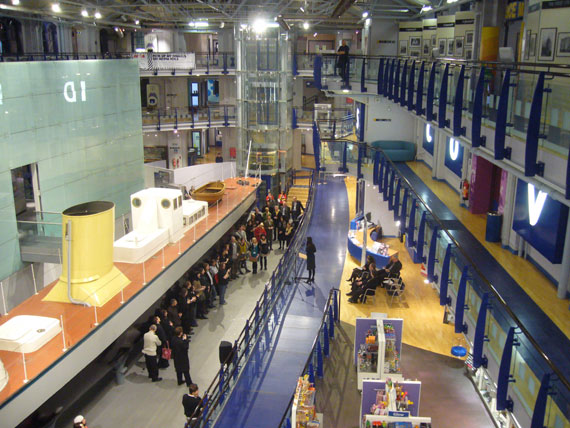
Yesterday I visited the Discovery Museum in Newcastle, the first science museum in Britain to be built outside of London. The place is vast with so much to 'discover', literally; I could have spent all day in there. There is an exhibit which takes you through the history of the Newcastle, from the Romans building Pons Aelius to the modern day. Of course, my personal favourite was the science maze. The maze takes you through the basics and fundamental concepts of science including: forces, how sound travels, electricity, and light and vision just to name a few. There are activities to try throughout the maze such as a ball game involving magnets and seeing how much electricity you can generate simply by completing a circuit using your hands and how the voltage increases when your hands are moist. It's a brilliant way for young people to gain  an interest in science; there were so many little children bewildered by making their own circuits and standing in front a kaleidoscope mirror. It's lovely to know that this brilliant exhibition might inspire one of these young children to take up science. The gift shop is also filled with sciencey goodness, I especially wanted the crystal growing kit. :-)

I still have to visit the Centre for Life and the Great North Museum amongst other things, so I'll write a little review of those next week.

Boe Rigg campsite

Kielder Water and Forest Park

and for any astronomy enthusiasts: Kielder Observatory

Discovery Museum

Wednesday, 16 July 2014

The downfalls of being indecisive

I am a very indecisive person, I always have been. So much so, that my family shout at me because I take so long to choose food in a restaurant. This indecisiveness is not helping the fact that I need to start looking at companies to do my third year placement at.

My course is 'MChem Chemistry with a year in Industry', so in third year I spend my time at a chemical company and I work for them for an entire year. The first issue to tackle was the sector of chemistry I wanted to go into. I enjoy inorganic and organic chemistry the most but my grades in inorganic have been higher, so I decided I wanted to go into inorganic to explore a little more about the things that have interested me, such as transition metal complexes and colour chemistry. I like the fact you're guaranteed to have pretty coloured products in inorganic, as childish as that sounds and I also really love inorganic labs at Uni.

My exam results really haven't been the greatest and I know I could have done better, however I've had a pretty tough year with being diagnosed with depression and bereavements etc. so I was quite happy to finish first year with a 2:1. This is pretty much the minimum to be able to get an industry placement so I'm quite nervous that I'm not going to be good enough. All I can do is smash it next year.

Recently, I've been looking into companies to apply to and at this moment in time, just thinking about it makes me anxious and nauseous. On one hand I can't imagine living on my own for a year away from everyone else at Uni, but at the same time I am secretly excited (just a minute bit though). I want to go somewhere I'll really love; after all, I will be working 9am-5pm, five days a week. The worst part is having to have an idea of where I want to work by September as I need to start applying, but at the moment, I'm totally not ready for this.

Wednesday, 9 July 2014

Kelham Island Museum

After exams had finished, my boyfriend and I decided to fully exploit the length of our accommodation contract and stay in Sheffield for a couple more weeks after the majority of people had moved out. We decided to do 'tourist' Sheffield and go to the sites that we would want to see if we were only visiting for a short period of time.

On our list was Kelham Island and specifically Kelham Island Museum. It sounds odd to have an 'island' in the centre of the steel city, but the previously the area has been home to many factories and was mainly industrial so a small ditch/trench was built that allowed water to reach the water mills. Hence the island was created.

As a lover of all types of museums and having recently covered the production of steel and metals as part of my degree course, I couldn't wait to get to to Kelham Island to visit their famous industrial museum. As you approach the museum, the first thing you see is a huge Bessemer converter outside. Bessemer converters were used to make steel from molten pig iron. Pig iron is iron with a fairly high amount of carbon, up to 4.5% by composition. The molten iron is placed into the Bessemer converter and the idea is to remove impurities such as silicon and carbon as oxides using the process of oxidation. Oxidation also heats the converter meaning the iron inside remains molten throughout the process. Other substances could then be added to the molten steel to make the desired product. 

The Bessemer converter at Kelham Island Museum (Source)
From the outside the museum looks relatively small compared to the disused and abandoned factories that surround it, and of course the Bessemer converter. However, once inside, the place really is amazing and much bigger that expected. I was surprised at how big the museum actually is and it covers everything from the origins of the City of Sheffield including the city cannons, to the stories of women working in the factories, which I found particularly fascinating. 

There is a part of the museum that focuses on the making of cutlery in the surrounding area and there are so many beautiful artefacts including a pair of silver scissors beautifully engraved and in the shape of two birds. Apart from the Bessemer, I'd say the museum's main attraction is the River Don Engine in the engine house. Several times a day, they turn the engine on for visitors to watch it in action. Unfortunately we didn't know what the loud noise and banging was until we turned the corner and the spectacle was over. :( 
The River Don Engine (Source)
I really enjoyed Kelham Island Museum, it's such an interesting place. If only I'd visited before my exam...

Follow my blog with Bloglovin